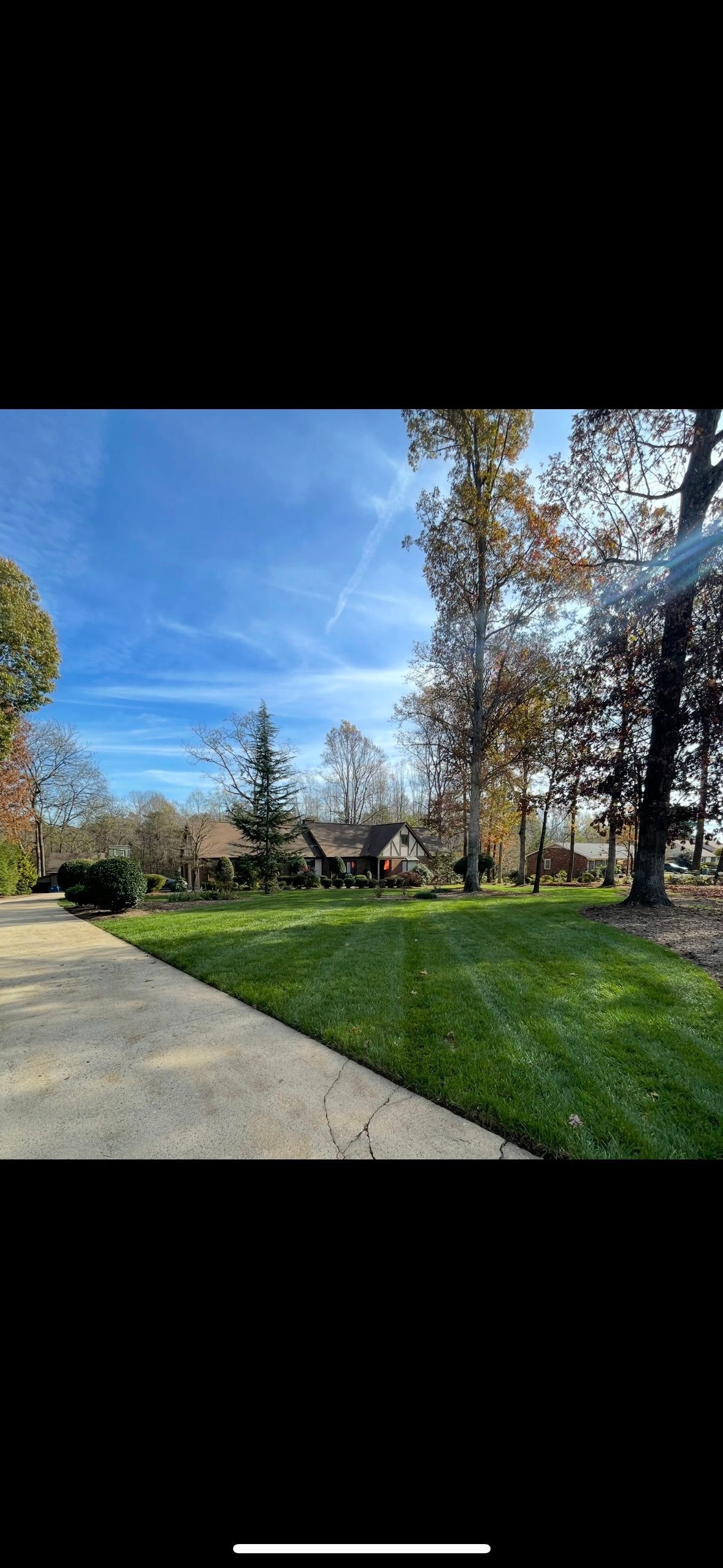
Grading Solutions That Protect Mooresville, NC Homes From Water Damage
Proper grading around your Mooresville, NC home directs water away from your foundation and prevents the pooling that causes long-term damage.
What Does Residential Grading Actually Involve?
Grading is the process of reshaping the ground surface around your property so that water flows in a controlled direction instead of collecting where it can cause problems.
The work starts with a site evaluation. A professional crew walks the property, identifies low spots where water collects, checks the slope near the foundation, and determines where runoff naturally exits the lot. From there, a plan is created to adjust the grade using equipment that moves and compacts soil to the right elevation and angle. The goal is to establish a consistent slope that carries stormwater away from the house, garage, and any other structures on the property.
Most residential grading projects require a minimum slope of about two percent away from the foundation walls. That translates to roughly a six-inch drop over the first ten feet of distance from the house. If the existing grade is flat or tilted toward the structure, water sits against the foundation after every rain event, eventually seeping into basement walls or crawl spaces. Professional grading corrects these conditions before they lead to structural issues. Check our frequently asked questions to learn more about how grading projects work from start to finish.
Signs Your Yard Needs Professional Grading Work
Several visible clues indicate that your yard's grade is not directing water properly, and catching these signs early can save you from larger repairs down the road.
Standing water that lingers more than a day after rainfall is one of the most obvious indicators. If puddles form in the same spots every time it rains, the ground in those areas sits lower than the surrounding grade and needs to be built up or resloped. Erosion channels along the edge of the house or through the yard are another sign. These channels form when fast-moving water carves paths through soil that lacks the grade or cover to resist it.
Water stains on basement walls, musty odors in lower-level rooms, and damp crawl spaces all point to water reaching the foundation. Even minor moisture intrusion can lead to mold growth and wood rot over time if the source is not corrected. Soft, spongy areas in the lawn where the ground never fully dries also suggest subsurface drainage issues that grading can resolve by redirecting how water moves across the lot.
Can Poor Drainage Damage Your Foundation Over Time?
Water that repeatedly sits against a foundation creates hydrostatic pressure, which is the force exerted by standing water pushing against below-grade walls.
Over months and years, that pressure causes hairline cracks to widen, mortar joints to deteriorate, and block or poured concrete walls to bow inward. In clay-heavy soils like those found across Iredell County, the problem intensifies because clay holds moisture longer and expands as it absorbs water. When the clay dries, it contracts and pulls away from the foundation, leaving gaps where the next round of rain can penetrate even deeper.
Foundation repairs are among the most expensive fixes a homeowner can face. Correcting the grade around the house is a preventive measure that addresses the root cause of water intrusion rather than patching symptoms after damage has occurred. A grading project that redirects stormwater away from the foundation protects the structural integrity of your home and can extend the life of your basement waterproofing systems.
How Mooresville's Lakeside Terrain Creates Unique Grading Challenges
Mooresville's geography near Lake Norman creates terrain conditions that make proper grading particularly important for residential properties.
Many neighborhoods in the area were developed on land that slopes toward coves, creeks, and drainage channels that feed the lake. Properties along Brawley School Road, Langtree, and the neighborhoods near Morrison Plantation sit on lots where the natural grade runs downhill toward water features, and builders often had to reshape terrain during construction to create level building pads. Over time, settled fill soil can shift and alter the drainage patterns that were established during development, sending water back toward foundations instead of away from them.
The red clay soils common throughout Iredell County compound these terrain challenges. Clay absorbs rainfall slowly and sheds runoff quickly across the surface, which means even a modest storm can send sheets of water across a yard if the grade does not channel it effectively. Properties on steeper lots may also need swales or French drains installed alongside grading work to manage the volume of water moving across the site during heavy rain events.
Correcting your yard's grade protects your foundation, eliminates standing water, and gives you a drier, more usable outdoor space. Connect with NC Hardscape and Design at 828-449-0337 to discuss grading solutions for your property. You can also learn about our hands-on approach on the about us page.